
Sports Flooring Standards Deconstructed
What are the pieces that make up a good sports surface? Read on for a deep dive that will turn you into the resident sports flooring expert.
How do you learn to build something? Take it apart first. If you read a biography of Albert Einstein, you will learn that as a child he enjoyed taking apart clocks and pocket watches to discover how they worked. Maybe he was literally looking for time so he could understand it better, even in childhood. Consider Leonardo Di Vinci as well. He sought to paint more lifelike figures examining skeletal structure and understanding muscle anatomy.
Einstein and Di Vinci show us is that mastering a subject comes from understanding the pieces that make up the whole. As it applies to architecture, is it sufficient to know that a material meets this or that testing standard? Maybe, but is it better to comprehend the reasons and methods that make the standard meaningful? Absolutely.
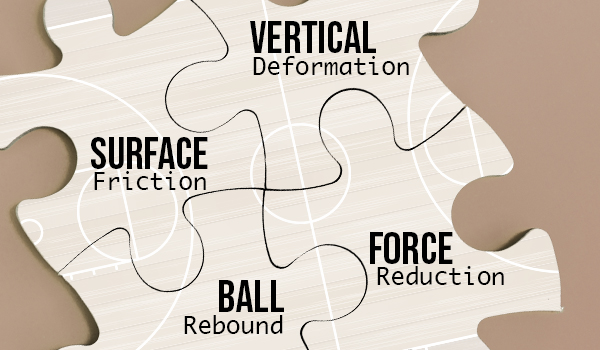
Take ASTM F2772 for example. Did you know that there are ASTM standards within ASTM standards? The sports flooring standard has four components: ball rebound (ASTM F2117), force reduction (ASTM F2569), surface friction (ASTM E303), and vertical deformation (ASTM F2157). Knowing that a gym floor meets these requirements is essential, but knowing what each component means is a pathway to mastery of sports flooring specifications. You will be able to make more nuanced product evaluations and plan with more specificity. At the very least, you will gain a confidence that only comes from studying beyond the basics. If you are ready for a little “demo” work, let’s break apart the ASTM F2772 standard into little pieces with the sledgehammer of intellectual curiosity.
Ball Rebound: Either a floor has it or it doesn’t…but, what is “it” anyway? Like every good experiment, measuring ball rebound starts with a control. A ball is dropped on a concrete surface and the rebound height is observed. Then, the rebound on the floor is compared to concrete in terms of a percentage. To pass, the threshold is 90%. That means the ball must rebound at least 90% of the height it would have rebounded on the concrete control surface.
Honestly, passing the rebound requirements isn’t difficult. Unless the surface being tested is a shag carpet or a playground sandbox, this standard is usually met. However, with ball rebound and every other standard discussed here, there is a uniformity requirement as well. In this case, that means the rebound percentage cannot vary any more than 3% across the entire surface.
The uniformity standard, which is often taken for granted, is where your depth of understanding can pay off. If a flooring manufacturer claims their surface has a 90% ball rebound, you can follow up with “Yes, but does it meet the 3% uniformity tolerance defined in ASTM F2117?” If you are met with a blank stare or a long awkward silence, kindly show that sales rep to the door.
Force Reduction: This property measure the degree of attenuation when a weight is applied to the surface. Of the four properties that make up the ASTM F2772 sports flooring standard, force reduction is the one you will see a lot of communication about. The reason is that it isn’t just a “pass or fail” standard. This one can be used to distinguish one sports floor from another. Firstly, there is a minimum 10% attenuation. Anything below that is insufficient to be called a sports floor. Above that threshold, classes increase incrementally in 10% ranges from class 1 to class 5. Class 5 is the only exception as it includes values 58% and above.
You might be asking why there are ranges at all. Why not just specify the exact force reduction value? The answer is related to scale and perceivable differences. You might have heard that LED light bulbs actually flicker on and off, but they do this so rapidly that your eyes and brain can’t perceive it. A similar phenomenon occurs with force reduction. Most people wouldn’t be able to tell the difference between 32% and 33%. So the class ranges in ASTM F2772 make the distinctions meaningful.
Surface Friction: To understand this property, it is important to understand the types of activities that occur on an indoor sports surface. Sports like basketball, volleyball, and others require movements like pivoting, running, and even diving. To safely accomplish these activities, a floor can’t be too slippery or have too much grip underfoot. In ASTM F2772, coefficient of friction values must fall between 80 and 110.
What makes surface friction controversial is its subjectivity. Although there is defined range of acceptable friction, some athletes might prefer values at one end of the range or another. As with the ball rebound property, the key is uniformity. Here, surface friction cannot vary more than 4 points in the specified area. That means, whether the floor corresponds to preferences or not, surface friction will be consistent throughout, lessening the likelihood of a slip or fall.
Vertical Deformation: If someone jumps on a trampoline, what happens? Vertical deformation. In fact, it wouldn’t be much of a trampoline if the surface did not deform under your feet to cushion your fall and send you upward again. That is essentially what is measured here, but on a less exaggerated scale. Sports floors deform underfoot in order to provide cushion. But, unlike the trampoline, too much deformation can become a tripping hazard. This standard specifies what is a historically acceptable amount of deformation and confirms that the property is uniform across the surface.
Here is something else to consider. If you are writing specifications for hardwoods versus resilient floors, the acceptable range of vertical deformation is different. Area-elastic floors like hardwood systems move vertically much more than point-elastic resilient floors. Thus, the ASTM F2772 separates acceptable ranges into categories. It’s something to keep in mind to avoid comparing apples and oranges. If a floor passes this criteria of ASTM F2772, it doesn’t necessarily mean it will have the same deformation value as another floor that also passes.
If you are interested in exploring the ASTM F2772 sports flooring standard in more depth, consider scheduling an in-person presentation from Abacus Sports. We are an AIA continuing eduction provider who can provide learning units (LU) in health, safety, and welfare (HSW). Contact us today!